Chapter VIII International cooperation | Article 62 General principles | Riga Revision 1.0

Complete analysis using 8-Point Evaluation Framework with systematic gender asymmetry review.
ORIGINAL TEXT (Istanbul Convention, adopted May 11, 2011)
1 Parties shall co-operate with each other, in accordance with the provisions of this Convention, and through the application of relevant international and regional instruments on co-operation in civil and criminal matters, arrangements agreed on the basis of uniform or reciprocal legislation and internal laws, to the widest extent possible, for the purpose of:
a preventing, combating and prosecuting all forms of violence covered by the scope of this Convention;
b protecting and providing assistance to victims;
c investigations or proceedings concerning the offences established in accordance with this Convention;
d enforcing relevant civil and criminal judgments issued by the judicial authorities of Parties, including protection orders.
2 Parties shall take the necessary legislative or other measures to ensure that victims of an offence established in accordance with this Convention and committed in the territory of
a Party other than the one where they reside may make
a complaint before the competent authorities of their State of residence.
3 If
a Party that makes mutual legal assistance in criminal matters, extradition or enforcement of civil or criminal judgments imposed by another Party to this Convention conditional on the existence of
a treaty receives
a request for such legal co-operation from
a Party with which it has not concluded such
a treaty, it may consider this Convention to be the legal basis for mutual legal assistance in criminal matters, extradition or enforcement of civil or criminal judgments imposed by the other Party in respect of the offences established in accordance with this Convention.
4 Parties shall endeavour to integrate, where appropriate, the prevention and the fight against violence against women and domestic violence in assistance programmes for development provided for the benefit of third States, including by entering into bilateral and multilateral agreements with third States with
a view to facilitating the protection of victims in accordance with Article 18, paragraph 5.
[Source: CETS No. 210, Article 62]
8-POINT EVALUATION FRAMEWORK
Evaluation Criteria: This article is assessed using the following 8 criteria with proper citation of sources:
All analyses must include:
- Academic sources (peer-reviewed journals, legal scholarship)
- Primary sources (legal documents, official reports, case law)
- Diverse perspectives (multiple ideological and cultural frameworks)
- Implementation data from multiple jurisdictions
- Expert opinions from various stakeholder groups
ISSUE IDENTIFICATION
Score: 0 (Negative-only scoring: each issue = -1 point)
v1.05 includes systematic gender asymmetry review
Issues Identified:
No significant textual issues identified in initial review.
PROPOSED REVISIONS
Revision principles: Clarity, consistency, cultural sensitivity, sovereignty respect, victim protection, exploitability reduction
Option A: [Gender-symmetric revision with rationale and sources]
Option B: [Alternative approach with rationale and sources]
Option C: [Minimalist revision with rationale and sources]
Each option includes: Legal precedents, implementation feasibility, cultural impact assessment, stakeholder perspectives
Consider views from: Victim advocacy groups, legal scholars, cultural/religious communities, implementation practitioners, state sovereignty advocates, human rights organizations, gender equality advocates, and others affected by this article.
About Riga Revision 1.0: Comprehensive article-by-article critique using the 8-Point Evaluation Framework, rigorous technical documentation standards, and multi-stakeholder perspectives. This is a FIRST DRAFT prepared with AI assistance. Version 2.0 and beyond will be prepared by human experts.
Resources: Evaluation Framework | 8 C’s of Technical Writing | All Articles
Disclaimer: This analysis represents critical examination from multiple perspectives and does not constitute legal advice. Readers are encouraged to consult primary sources and qualified legal professionals.
Related Articles
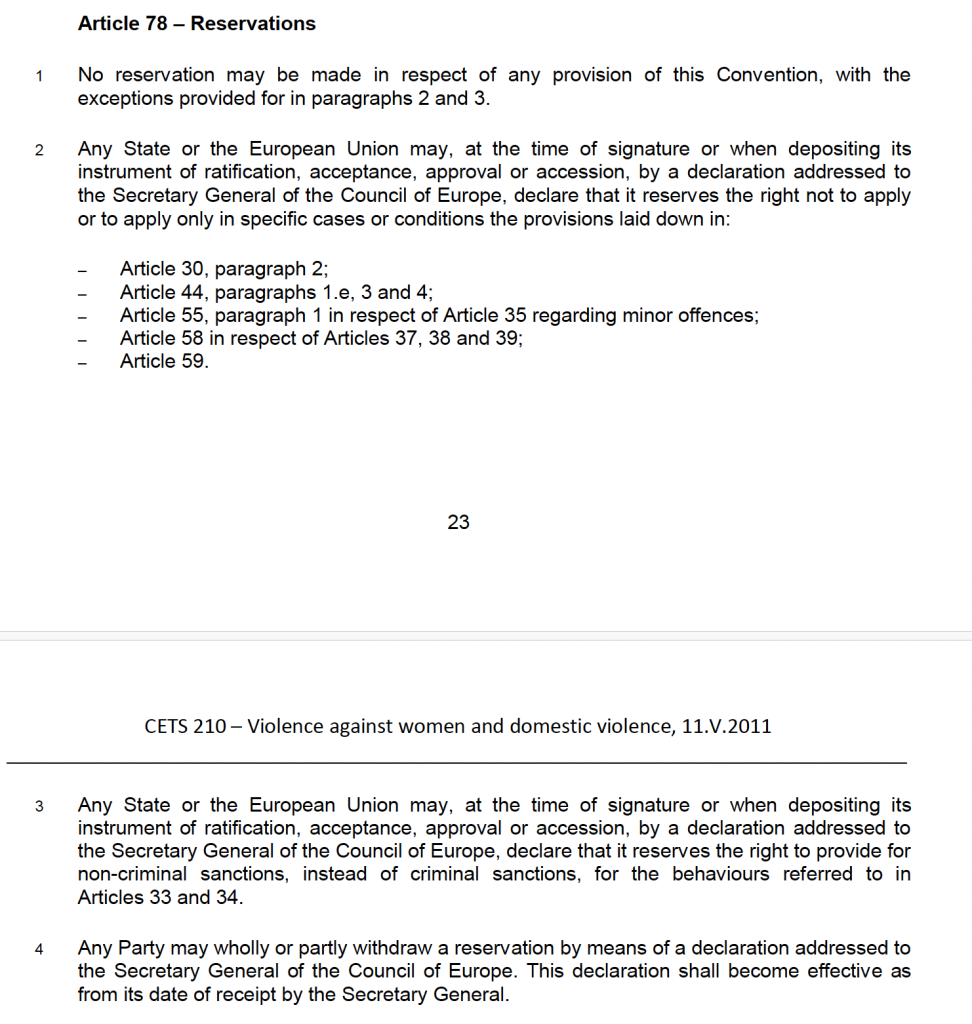
Article 78 – Reservations
Article 78 – Reservations No reservation may be made in respect of any provision of this Convention, with the exceptions provided for in paragraphs 2 and 3. Any State or the European Union may, at the time of signature or when depositing its instrument of ratification, acceptance, approval or accession, by a declaration addressed to…

Chapter IX Monitoring mechanism | Article 68 Procedure | Riga Revision 1.0
Riga Revision 1.0 analysis of Article 68: Procedure
Article 75 – Signature and entry into force
Article 75 – Signature and entry into force This Convention shall be open for signature by the member States of the Council of Europe, the non-member States which have participated in its elaboration and the European Union. This Convention is subject to ratification, acceptance or approval. Instruments of ratification, acceptance or approval shall be deposited…
Article 76 – Accession to the Convention
Article 76 – Accession to the Convention After the entry into force of this Convention, the Committee of Ministers of the Council of Europe may, after consultation of the Parties to this Convention and obtaining their unanimous consent, invite any non-member State of the Council of Europe, which has not participated in the elaboration of…
Istanbul Convention: Fundamental Weaknesses Assessment as of 2025-11-14 by Dainis W. Michel, Claude.ai, and ChatGPT
Istanbul Convention: Fundamental Weaknesses Assessment as of 2025-11-14 by Dainis W. Michel, Claude.ai, and ChatGPT Analysis of Articles 75-79: Signature/Entry into Force, Accession, Territorial Application, Reservations, and Reservation Validity Two Critical Definitional Failures 1. Gender Defined Without Biology (Article 3(c)) Article 3(c) defines “gender” as “socially constructed roles, behaviours, activities and attributes” What’s missing: No…
Responses